What Is a Website Audit? Why Most Websites Need One Sooner Than They Think
2026-06-095 min read
2026-06-095 min read

A surprising number of websites are underperforming without anyone realising it.
Nothing looks obviously broken.
Pages load.
Forms work.
The design still feels modern enough.
Yet leads are lower than expected. Organic traffic plateaus. Users leave before taking action. Internal teams feel like the website should be doing more.
This is exactly why website audits exist.
A website audit is a structured review of how a website performs across user experience (UX), performance, search engine optimisation (SEO), accessibility and technical health. Its purpose is not simply to identify errors. It is to uncover the hidden issues preventing a website from performing at its full potential.
For marketing leaders, digital teams, software as a service (SaaS) businesses and growing brands, a website audit is often the fastest way to understand what is helping performance — and what is quietly holding it back.
A website audit is a comprehensive assessment of a website’s effectiveness.
Rather than looking at design alone, a proper audit evaluates multiple areas at once:
The goal is simple:
Identify what is working, what is not, and what should be improved first.
Think of it less as a website check-up and more as a performance review for your entire digital experience.
Because websites rarely fail all at once. They degrade over time. New content gets added.
Plugins accumulate.
Business priorities change.
Marketing campaigns evolve.
Artificial intelligence (AI)-generated content appears
Different teams make changes independently.
Eventually, the website that launched two years ago becomes very different from the website visitors experience today.
Most businesses assume they have a website problem when performance drops. Often they actually have a visibility problem. The issues were already there — they just weren’t being measured.
A meaningful website audit should go beyond technical diagnostics. It should answer practical business questions.
How fast does the website load? Are users waiting longer than they should? Are heavy assets, scripts or technical bottlenecks affecting performance?
Can visitors find what they need quickly? Are journeys intuitive? Do users encounter unnecessary friction?
Where are visitors dropping off? What is preventing action? Are calls-to-action visible and persuasive?
Can search engines understand the website? Are there missing metadata issues, duplicate headings or crawlability problems?
Can everyone use the website regardless of ability? Are there barriers affecting usability and compliance?
Are there hidden errors, broken elements, outdated components or structural issues that could create future problems?
Some warning signs are obvious. Others are much harder to spot.
Common indicators include:
If any of these sound familiar, an audit is usually worth doing.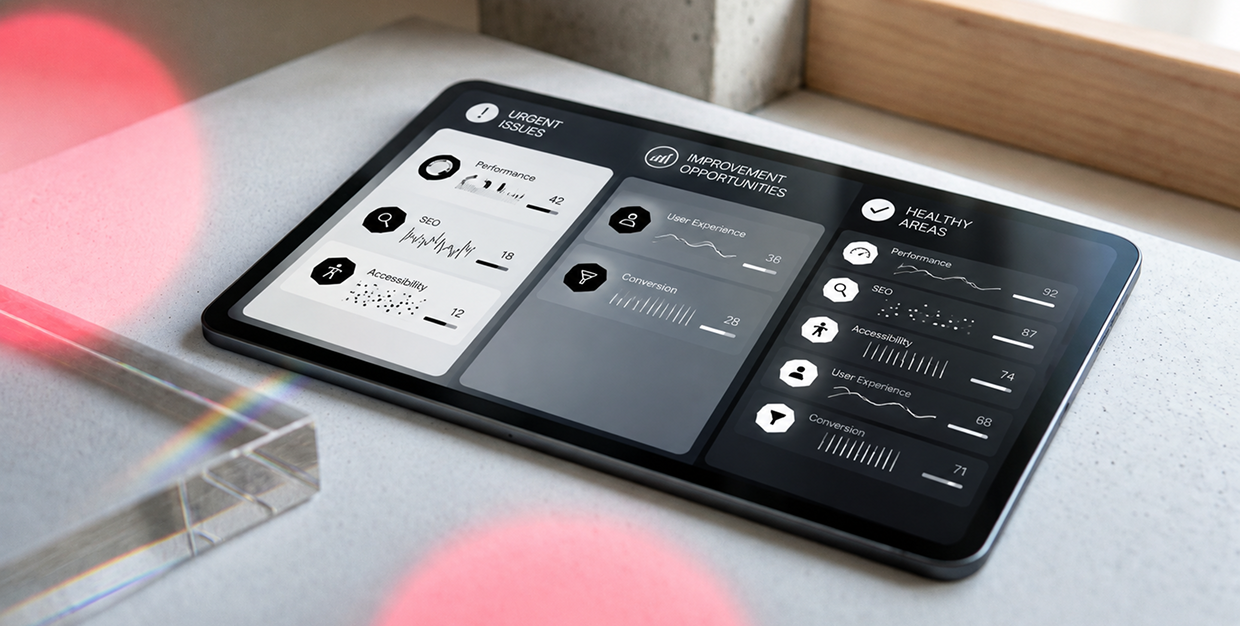
One of the biggest misconceptions in digital is that every website problem requires a redesign. It doesn’t. Many websites do not need rebuilding. They need improving.
| Situation | Audit & Upgrade | Full Redesign |
|---|---|---|
| Traffic declining | ✓ | Sometimes |
| Slow performance | ✓ | Rarely |
| UX friction | ✓ | Sometimes |
| SEO issues | ✓ | Rarely |
| Outdated brand | Sometimes | ✓ |
| Major business shift | Sometimes | ✓ |
| Platform limitations | Sometimes | ✓ |
A redesign should be the last answer, not the first. Many businesses can unlock significant gains through targeted optimisation rather than starting from scratch.
At minimum:
Websites are not static assets. They are operating systems for your brand, marketing and customer experience. Regular reviews help prevent small issues becoming expensive problems.
One thing we noticed repeatedly at Digiten was that clients often knew something felt wrong with their website. They just couldn’t see exactly what it was. So we built our own AI-powered website audit tool.
You enter a Uniform Resource Locator (URL).
The system analyses the site, then generates a report covering:
The goal isn’t to replace human expertise. It’s to make identifying issues faster, clearer and more accessible. Because not every conversation needs to start with a sales call.
The best websites are not necessarily the most beautiful. They are the ones that consistently perform.
They attract visitors.
They help people find answers.
They support business goals.
And they evolve as expectations change.
A website audit is often the fastest way to understand whether your website is genuinely performing — or simply appearing to. The difference can be worth far more than most businesses realise.