10 Signs Your Website Is Holding Your Business Back
2026-09-165 min read
2026-09-165 min read

A website can look perfectly fine and still underperform. That’s what makes website problems difficult to spot.
Unlike a broken checkout or a server outage, most website issues don’t announce themselves. They show up quietly through lower conversion rates, weaker engagement, frustrated users and missed opportunities that never make it into a report.
For marketing directors, digital teams and business leaders, the challenge is rarely recognising that a website matters. The challenge is knowing when an existing website has stopped supporting growth and started limiting it.
If any of the signs below sound familiar, it may be time to take a closer look.
This is often the first warning sign.Your search engine optimisation (SEO) is improving. Campaigns are driving visitors. Awareness is increasing.
Yet enquiries, leads or sales remain flat.
When traffic and outcomes move in different directions, the issue is rarely visibility. More often, it is the experience visitors encounter once they arrive.
The website attracts attention but struggles to convert it.
Many websites provide information but fail to guide decisions. A visitor lands on the site, browses a few pages and leaves without taking action.
Not because they were uninterested.
Because the journey was unclear.
Strong websites remove friction. They help users understand where they are, what matters and what happens next.
Speed affects far more than user experience (UX).It influences engagement, conversion, search visibility and brand perception. Users rarely complain about slow websites.
They simply leave.
If your site feels sluggish, loads inconsistently or struggles on mobile devices, there is a good chance performance is already affecting results.
SEO is often treated as a content problem. In reality, many SEO issues are structural. Poor technical foundations, weak page architecture, accessibility issues and performance problems can all limit visibility.
If rankings have stalled despite ongoing content activity, the website itself may be part of the problem.
Most websites are designed on large screens and tested on smaller ones. Users experience them the other way around.
If forms are difficult to complete, content is hard to navigate or key actions feel awkward on mobile, potential customers are encountering unnecessary friction.
And friction costs conversions.
This is one of the most overlooked warning signs. If making simple updates feels slow, risky or frustrating, the website is creating internal friction as well as external friction. Teams start delaying improvements. Content becomes outdated.
Campaigns take longer to launch.
Over time, the platform becomes a bottleneck rather than an asset.
Businesses change constantly. Services expand. Positioning shifts. Markets evolve. Yet many websites continue telling the story of a company that no longer exists.
When the website no longer reflects the reality of the business, prospects receive the wrong impression before a conversation even begins.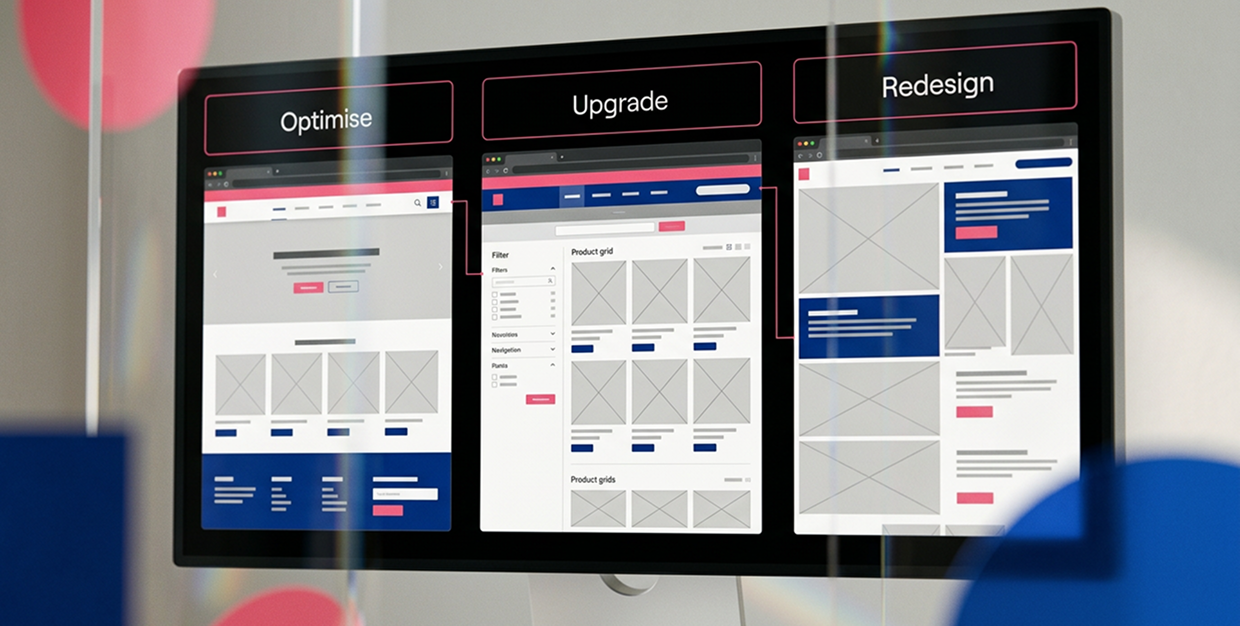
Not every bounce rate is a problem. But when visitors consistently leave key commercial pages without progressing, it deserves attention.
Service pages.
Product pages.
Pricing pages.
Contact pages.
These areas should help people move forward, not encourage them to leave.
Customers rarely interact with a website in isolation. They arrive through campaigns, events, referrals, social content and sales conversations.
The best websites feel connected to everything around them. When messaging, experiences and expectations become disconnected, conversion rates usually suffer.
Perhaps the clearest sign of all.
Questions like:
“Should we redesign the site?”
“Do we need a new platform?”
“Is performance actually an issue?”
often get answered through assumptions rather than evidence.
Without visibility into performance, user behaviour, technical health and conversion opportunities, teams are left guessing. And guessing is expensive.
| Sign | Business Impact |
|---|---|
| Traffic up, leads flat | Lost conversion opportunity |
| Users don’t know what to do | Journey friction |
| Slow performance | Lost engagement |
| SEO plateau | Reduced visibility |
| Poor mobile UX | Lost conversions |
| Difficult to update | Internal inefficiency |
| Outdated positioning | Weaker brand perception |
| High page exits | Lost opportunities |
| Disconnected customer journey | Inconsistent experience |
| Decisions based on opinion | Poor prioritisation |
Not every problem requires a complete rebuild. In fact, many websites can improve significantly through targeted optimisation.
| Situation | Upgrade | Redesign |
|---|---|---|
| Performance issues | ✓ | |
| SEO and accessibility gaps | ✓ | |
| User journey improvements | ✓ | |
| Outdated visual identity | ✓ | |
| Major repositioning | ✓ | |
| New business model | ✓ | |
| Platform limitations | ✓ or Redesign | ✓ |
One of the biggest mistakes organisations make is assuming every problem requires a redesign.
Often, the smarter and more cost-effective approach starts with understanding what already exists.
Before investing in a redesign, rebuild or new platform, it helps to understand what is actually happening beneath the surface.
At Digiten, we regularly see websites that appear healthy but contain hidden issues affecting performance, SEO, accessibility, conversion and user experience. That is exactly why we built our free website audit.
Rather than relying on assumptions, the audit provides a clear view of what is working, what is getting in the way and where improvements are likely to have the biggest impact.
Because the best digital decisions are rarely based on instinct alone. They’re based on evidence.